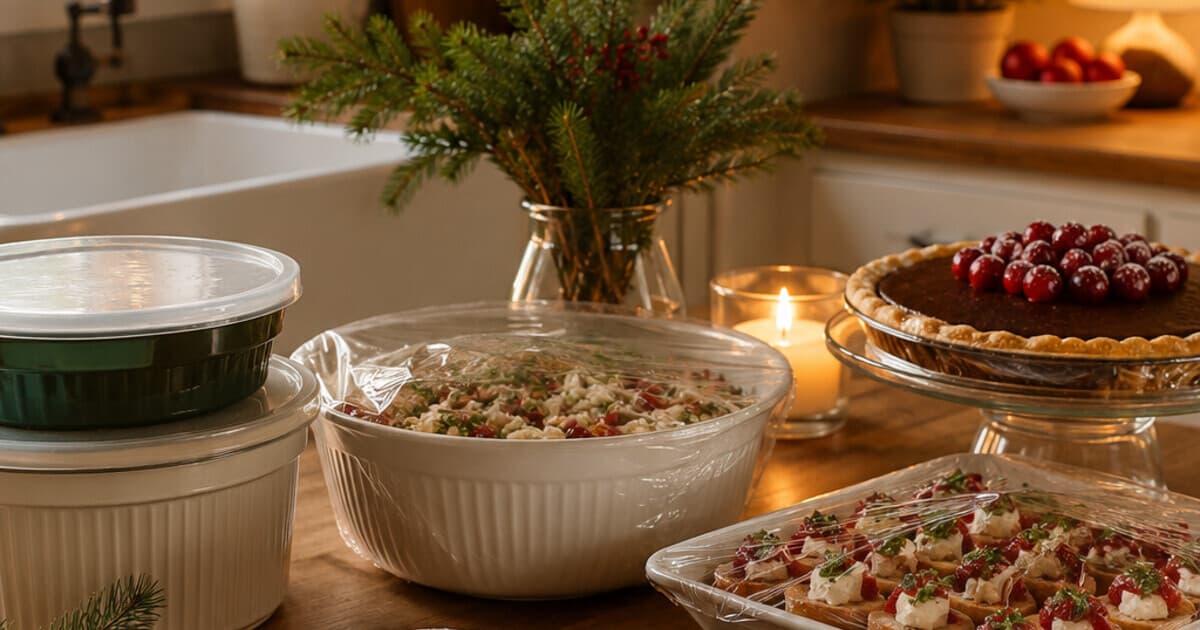
"Make it ahead" is only useful advice when it says what can move earlier and what still has to happen near serving. A party menu can look easy on paper and still create a terrible final hour if six dishes all need baking, crisping, dressing, garnishing, or refrigerator space at once. The better approach is to label every dish by its earliest recipe-supported prep window and its final action, then spread those actions across the day. This timeline is about scheduling, not declaring new food-storage rules.
QUICK REFERENCE
Four prep lanes for a party menu
| Lane | Good fit | Watch for |
|---|---|---|
| Day before | Recipe-supported cooked/prepped components | Storage + texture changes |
| Earlier party day | Chilled assembly, chopping, sauces | Fridge space |
| Last 2 hours | Reheating, roasting, final baking | Oven/stovetop collisions |
| Last hour | Fragile garnish, dressing, crisp finish | Too many simultaneous tasks |
Start with each recipe's actual make-ahead window
For every dish, read the instructions and notes you are actually using. Write the earliest point the recipe says you can prepare it and how it should be stored. If the recipe says a dip can be made two days ahead, that is useful. If it says nothing about overnight storage, do not automatically promote it into the day-before lane because the schedule would be easier.
Also write the final step: uncover, bake, reheat, dress, garnish, broil, slice, stir, or simply set out. The final step is what creates party-day workload. Two dishes can both be "made ahead" and still collide if each needs thirty minutes in the same oven right before guests eat.
Day before: move complete, stable work first
The day-before lane is best for components or finished dishes that the recipe explicitly says hold well. That often includes sauces, dips, desserts, cooked fillings, braises, some casseroles, washed or chopped sturdy vegetables, and measured dry ingredients—but the exact list depends on the recipe.
Use this day to reduce mess as well as cooking. Label containers, assign serving dishes, clear refrigerator space, chill drinks, and put serving utensils with the dishes they belong to. Removing decision-making from party day is almost as valuable as removing chopping.
Earlier party day: assemble without starting the final countdown
Morning or early afternoon is a good time for recipe-approved assembly, washing greens, portioning board ingredients, preparing garnishes that hold, setting up beverage components, and arranging dishes that will stay covered or chilled until later.
Do not build the entire buffet hours early if the food needs temperature control or will dry out, wilt, or become soggy. The goal is staged readiness. Keep the components ready so final setup takes minutes rather than making the final product wait unnecessarily.
Last two hours: protect the equipment-heavy steps
This lane usually contains the work that consumes the oven, stovetop, grill, or other shared equipment. Write those blocks on a timeline. If two reheats and a roast all need the same oven, the conflict exists even though the food was "made ahead." Solve it before the party by moving one dish earlier, choosing a side that is intended to be served at room temperature, using another suitable method, or simplifying the menu.
Treat refrigerator space as equipment too. A party with several chilled platters can create a different bottleneck if every shelf is full. Decide which items can stay in compact containers until the display surface is ready.
Last hour: reserve it for food that truly benefits from being last
The final hour should not contain every dish. It should contain the small number of tasks whose quality genuinely depends on late timing: dressing a salad, adding a crisp topping, slicing something that dries out, warming bread, finishing a delicate garnish, or setting out a chilled item at the appropriate time.
If you count seven or eight final-hour food tasks, the menu is giving you information. Move some work earlier using the recipe's own make-ahead guidance, reduce the number of hot items, or choose food with simpler final actions.
Do not confuse make-ahead convenience with food-safety permission
Storage and holding rules still apply. FDA guidance for buffets emphasizes keeping hot foods hot, cold foods cold, and replacing serving dishes rather than topping off old food with new food. Perishable food should not simply sit out because it was prepared earlier.
When a recipe includes cooling, refrigeration, reheating, or serving instructions, keep them in the timeline. Make-ahead planning is successful only when it moves work without deleting the steps that protect food quality and safety.
Make-ahead timeline template
Use these four lists when the menu is final. Every dish should appear once in the earliest lane its real recipe supports, plus its final action in the lane where that action belongs.
- Day before: complete stable recipes/components, sauces, desserts, labels, serving-dish assignments.
- Earlier party day: approved assembly, chopping, chilled components, drink setup, refrigerator staging.
- Last 2 hours: oven and stovetop blocks, reheating, roasting, final baking.
- Last hour: dressing, garnish, bread warming, crisp finish, final chilled setup.
- Arrival buffer: no new optional project starts.
- Serving: refill in smaller waves if a long buffet would compromise quality or safety.
Make-ahead checklist when the timeline still looks too busy
Remove one equipment-heavy dish before removing the simple cold item. Replace a second hot appetizer with something designed to be served at room temperature. Buy the bread. Serve dessert that is already complete. Ask a guest to bring an item that does not need your oven.
The best make-ahead menu is not the menu with the most homemade components. It is the menu whose remaining work matches the kitchen, time, and attention the host actually has. If perishable food will sit on a buffet, build the holding window into the schedule too: FDA says to discard perishables left at room temperature for more than two hours unless they are being held safely hot or cold, or after one hour when the ambient temperature is above 90°F.
TAKE IT TO PAPER
Useful printables for this plan
SOURCES
Sources & references
These links support factual rules, quantities, safety guidance, or planning context. The final prioritization and sequencing in this guide are editorial decisions. See how sources are chosen.
- Public guidanceFDA — Serving Up Safe Buffetsfda.gov
- Public guidanceUSDA FSIS — Keep Food Safe! Food Safety Basicsfsis.usda.gov
FAQ
Questions people ask before guests arrive
What party food can I make the day before?
Use the make-ahead guidance from the recipes you are actually following. Dishes and components that are explicitly designed to hold overnight belong in the day-before lane; do not assume every appetizer or assembled dish stores well.
How much cooking should be left for the last hour before a party?
Ideally only a small number of quality-sensitive final steps. If many dishes still need the same oven, stovetop, or active assembly, move recipe-approved work earlier or simplify the menu.
How do I plan make-ahead appetizers?
Write the earliest approved prep time and final action for each appetizer. Put stable prep earlier, reserve refrigeration space, and keep only fragile garnish, crisping, warming, or final assembly near guest arrival.
Can I reheat several make-ahead dishes at once?
Only when their recipe temperatures, timing, pan sizes, and oven capacity are compatible. If several dishes compete for one oven, schedule that reheat window separately instead of assuming make-ahead prep solved the conflict.