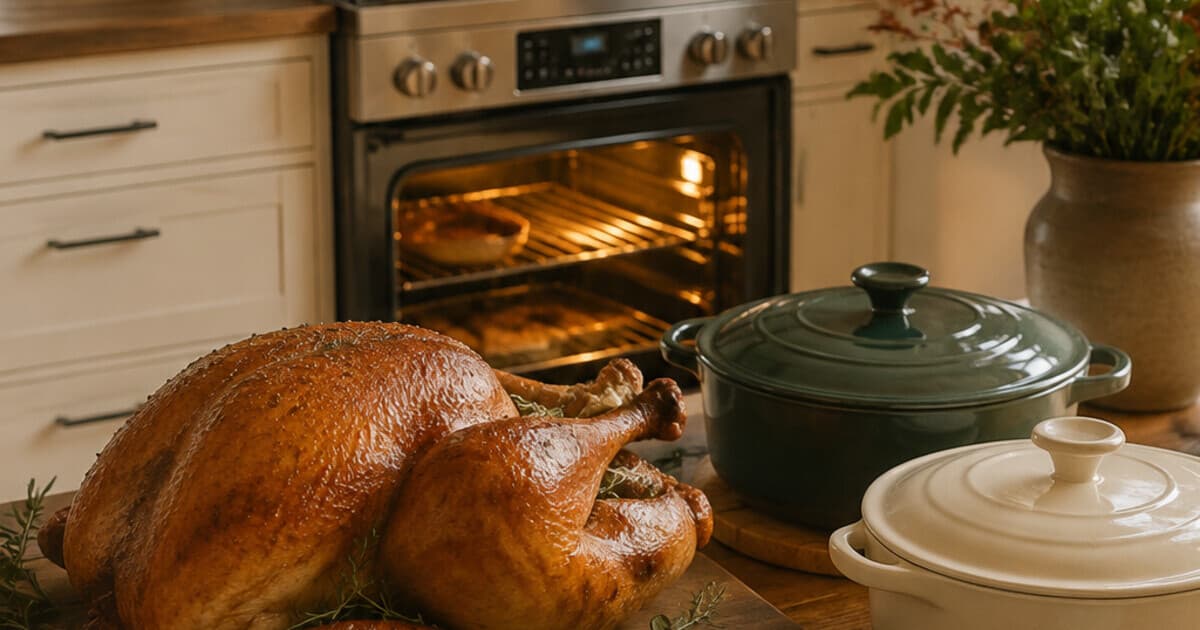
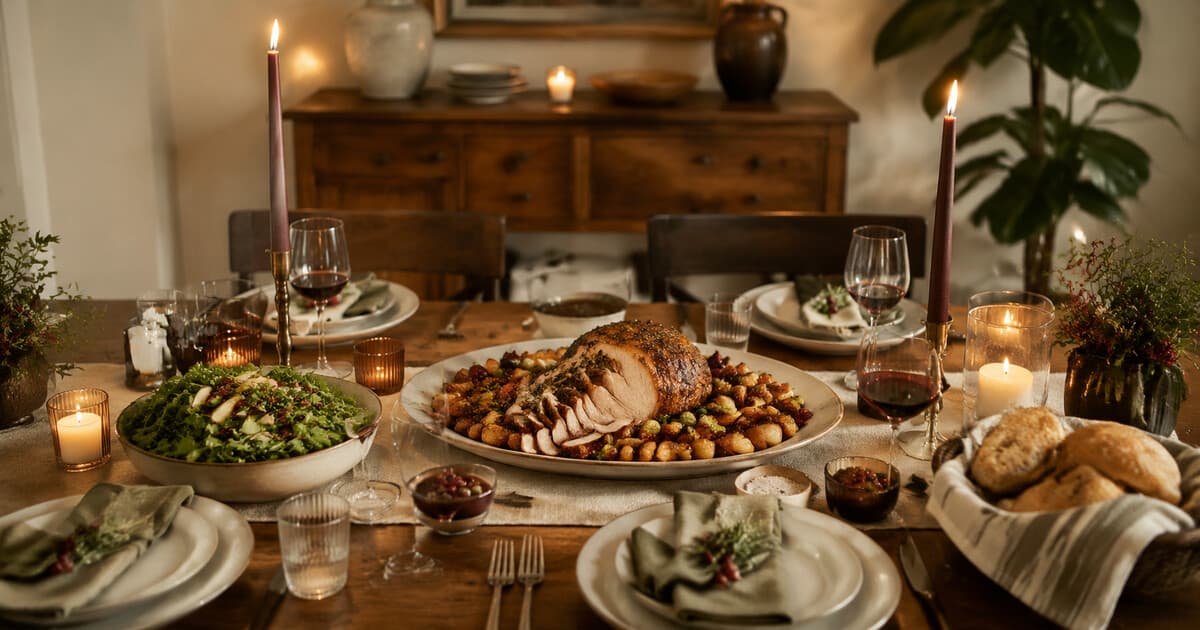
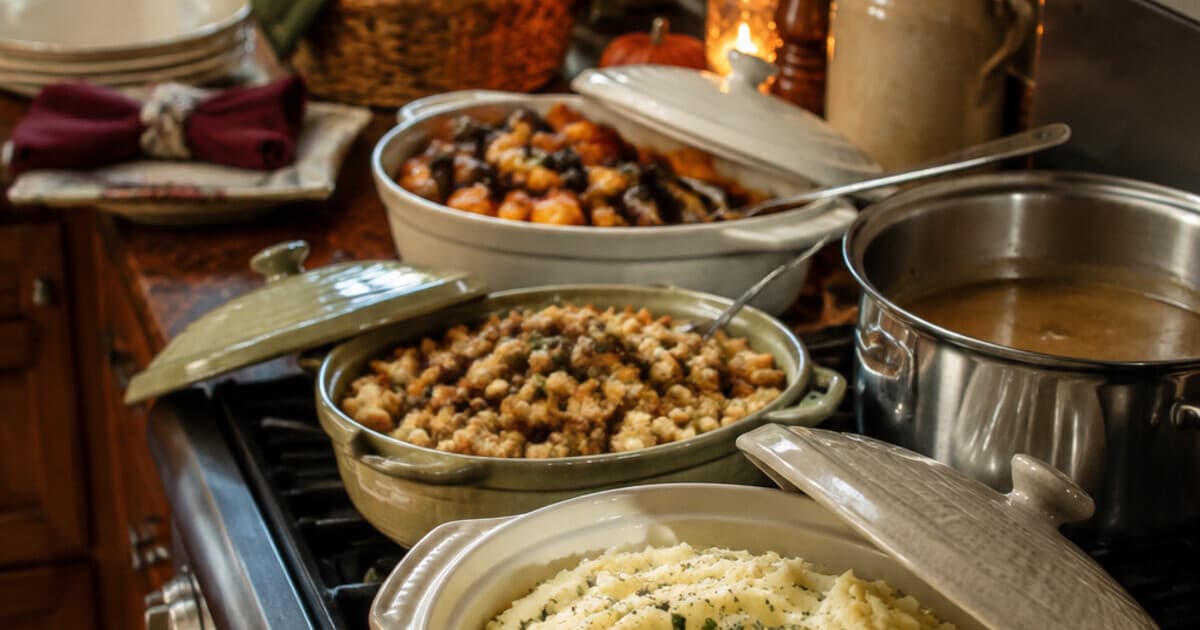
Cooking several dishes is mostly a scheduling problem. Each recipe may be simple on its own, but one oven has limited rack space, temperature settings, and time. A workable plan starts from the serving deadline, preserves the real recipe constraints, and uses rest or hold windows as flexibility. This method works for dinner parties, Sunday roasts, holiday meals, and any menu where several oven dishes need to reach the table together.
QUICK REFERENCE
The one-oven scheduling order
| Write down | Why it matters | What to do with it |
|---|---|---|
| Serve time | Creates one fixed deadline | Work backward from it |
| Recipe temperature + duration | Prevents invented shortcuts | Keep exact unless the recipe gives flexibility |
| Rack slots needed | A full oven has physical limits | Check overlap by time segment |
| Rest / hold window | Some dishes can finish early | Use the window as schedule buffer |
| Final fresh step | Some foods deteriorate while waiting | Keep them near serve time |
Start with the table time, not the first cooking step
Pick the time you want food on the table. That is the only useful starting point because every dish must eventually connect to it. Forward planning—starting with the first recipe and hoping the rest fit later—usually creates a crowded final hour. Reverse planning makes the conflicts visible before the oven is hot.
For every dish, write the moment it must be ready, then count backward through resting, holding, baking, roasting, or reheating. If a roast needs a rest before carving, the roast must leave the oven before the serving deadline. If a casserole can sit warm for twenty minutes, that window is useful flexibility. If a crisp pastry should be served immediately, give it a much tighter finish target.
Copy the real recipe constraints before you try to optimize
For each oven dish, record the temperature, cooking or reheating duration, pan size, rack space, and any rest time exactly as the recipe or package instructions state. Do not begin by averaging temperatures. A schedule should adapt to the food; the food should not be rewritten to make a pretty schedule.
Some recipes explicitly say a dish can bake at either of two temperatures, or they provide a range. That is genuine flexibility. If the instructions give one temperature only, treat that temperature as fixed unless you already know from a tested source that the dish can be adjusted. This matters most for proteins, breads, custards, delicate bakes, and anything where texture depends on heat.
- Dish name and serving deadline.
- Oven temperature or tested temperature range.
- Cook or reheat duration.
- Number of rack slots or amount of oven footprint needed.
- Resting or holding time that is actually acceptable.
- Whether the dish can move to stovetop, slow cooker, toaster oven, or—if the recipe is specifically intended for it—room-temperature service.
Choose one anchor dish and schedule it first
The anchor dish is the item with the least scheduling freedom. It may be the large roast, a turkey, a baked main, or a fragile item that must finish close to dinner. Lock that oven block first. Everything else must fit around it rather than competing with it as if every dish has equal priority.
An anchor does not have to be the most expensive dish. It is simply the one whose timing is hardest to move. A braise that reheats beautifully may be the centerpiece but still be flexible. A tray of popovers that must be served immediately could be the tighter constraint. The schedule should follow the actual constraints rather than the menu hierarchy.
Check rack capacity by the minutes that actually overlap
One common planning mistake is to count every dish that touches the same broad hour as if all of them occupy the oven at the same instant. Instead, draw each oven block on a timeline and check the short segments where they overlap. A long roast might overlap one side from 5:00 to 5:25 and another side from 5:30 to 5:55. If the two sides never overlap each other, you do not need rack space for all three at once.
Physical pan size matters too. Two recipes may be temperature-compatible and time-compatible but still not fit beside each other. Plan with your actual pans and usable racks. If a sheet pan blocks airflow around a deep casserole, the theoretical second slot may not be a useful slot in practice.
Use holding and resting windows as buffers, not as accidents
A dish that can finish fifteen or thirty minutes early is easier to schedule than a dish that must leave the oven at exactly 6:55. Write that acceptable early-finish window into the plan, but distinguish a quality hold from a food-safety hold: perishable hot food still needs safe hot holding rather than an indefinite counter rest. That buffer gives you room to absorb a slow oven, a late start, a temperature transition, or a crowded final rack.
Build temperature transitions into the schedule
An oven does not jump instantly from one setting to another. When two groups need incompatible temperatures, place a transition buffer between them. The exact time depends on the oven, how far the temperature is changing, and whether you are heating up or cooling down. Your schedule should acknowledge that transition rather than stacking two blocks edge to edge.
Move flexible food out of the final oven traffic jam
The easiest one-oven meal is not the meal with the cleverest rack arrangement. It is the meal where fewer things need the oven at the same time. Make dessert ahead. Use the stovetop for gravy, green vegetables, or mashed potatoes when that suits the recipe. Choose one side that is intended to be served at room temperature. Reheat a casserole earlier only if you have a safe holding plan for it rather than letting a perishable dish sit warm on the counter.
A sample reverse-timeline method
Suppose dinner is at 7:00. Dish A needs sixty minutes in the oven plus twenty minutes of rest. Dish B needs forty minutes and can finish up to twenty minutes early. Dish C needs fifteen minutes and should finish close to serving. First, place Dish A so its rest ends at 7:00. Then place Dish C as late as possible without violating rack or temperature limits. Finally, slide Dish B into the latest compatible open block inside its early-finish allowance.
If B and C both fit at the same temperature and rack capacity allows it, they can overlap. If the temperature is incompatible, insert the oven-change buffer and move B earlier. If B no longer fits, that is not a reason to shorten its recipe time. It is a signal to move B to another method, make it earlier, or change the menu.
What to do when the anchor dish runs late
Do not silently compress the remaining cooking times. Mark the anchor as occupying the oven for the extra minutes, then reflow everything that has not started. Use the holding flexibility of sides first. Move a reheating task to another suitable appliance if you already know that method works. If the original serving time is no longer realistic, move dinner rather than forcing unsafe or undercooked food.
This is why a written plan is useful: you can see what is movable and what is not. A ten-minute delay is easier to absorb when two sides have twenty-minute hold windows than when every dish was scheduled to finish at exactly the same second.
One-oven checklist before you preheat
Use this short check before cooking starts. If any answer is unknown, resolve it from the recipe or your equipment instead of guessing during the rush.
- Serve time is fixed and written down.
- Every oven dish has a real temperature and duration.
- The anchor dish has a protected oven block.
- Rack space has been checked with the actual pans.
- Temperature changes have transition time.
- Rest and hold windows are written into the plan.
- At least one side or dessert has been moved out of the final oven window.
- A thermometer or other doneness check required by the recipe is ready.
- You know what can move if the anchor runs late.
TAKE IT TO PAPER
Useful printables for this plan
SOURCES
Sources & references
These links support factual rules, quantities, safety guidance, or planning context. The final prioritization and sequencing in this guide are editorial decisions. See how sources are chosen.
- Public guidanceUSDA FSIS — Keep Food Safe! Food Safety Basicsfsis.usda.gov
- Public guidanceUSDA FSIS — Safe Minimum Internal Temperature Chartfsis.usda.gov
FAQ
Questions people ask before guests arrive
How do I cook several dishes at different temperatures in one oven?
Keep each recipe's tested temperature unless the instructions give flexibility. Group only genuinely compatible dishes, then use separate time blocks plus an oven-transition buffer for incompatible temperatures.
Should every dish finish at exactly the same time?
No. Give flexible dishes an acceptable early-finish or hold window. The tightest, least-holdable foods should finish closest to serving while sturdy sides can finish earlier.
Can two dishes use the oven at the same time?
Yes when their temperature requirements overlap and the actual pans fit without exceeding usable rack capacity. Check the minutes that truly overlap rather than treating the whole hour as one block.
What if the main dish is running late?
Extend its oven occupancy, then re-schedule only the dishes that have not started. Use real hold windows and alternate methods first; if the plan still does not fit, move the serving time rather than shortening another recipe.